A full-time, classical education with live online classes, flexible schedules, and no state testing requirements. Powered by the trusted Great Hearts curriculum and teachers you can count on! Courses are available through Private Pay or ESA payments in select states (AZ, UT, WV, NH).
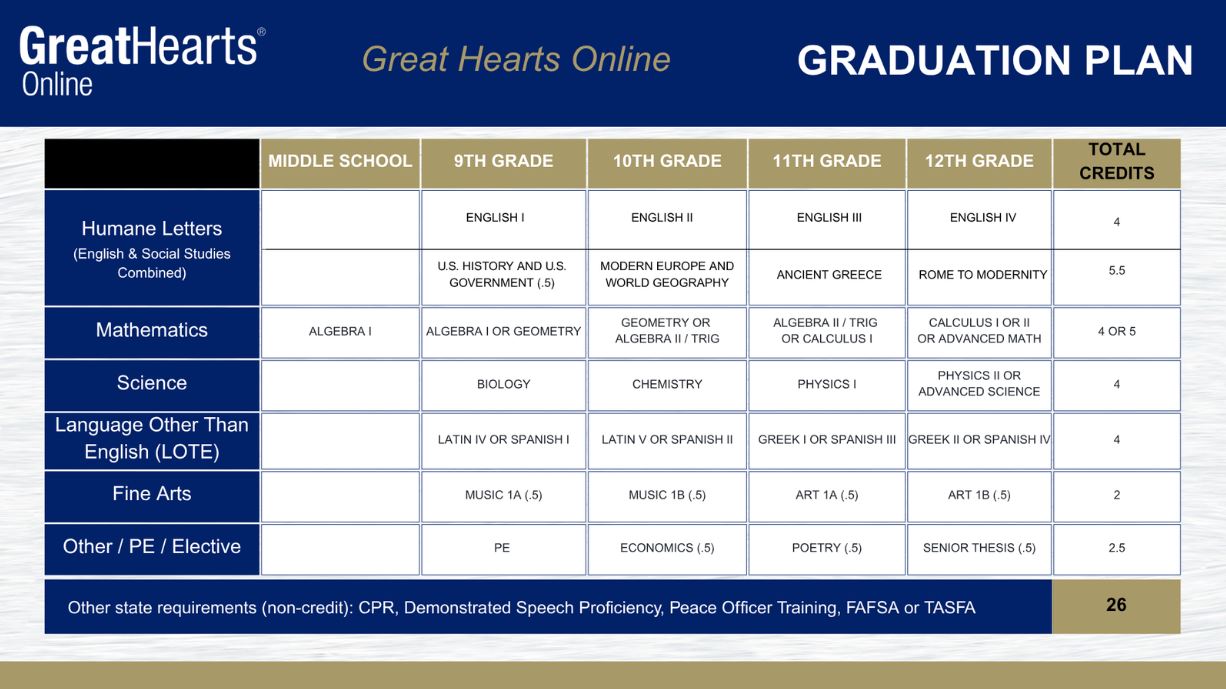
View the GHO High School Graduation Plan HERE.
This course product is for ONE (1) semester of the academic year only and awards (.5) credits per semester for a full credit upon completion of both semesters.
School supplies for this subject can be purchased individually once you have access to your course in the Canvas LMS.
View the GHO High School Graduation Plan HERE.
This course product is for ONE (1) semester of the academic year only and awards (.5) credits per semester for a full credit upon completion of both semesters.
School supplies for this subject can be purchased individually once you have access to your course in the Canvas LMS.
View the GHO High School Graduation Plan HERE.
This course product is for ONE (1) semester of the academic year only and awards (.5) credits per semester for a full credit upon completion of both semesters.
School supplies for this subject can be purchased individually once you have access to your course in the Canvas LMS.
View the GHO High School Graduation Plan HERE.
This course product is for ONE (1) semester of the academic year only and awards (1) credit for first semester and (.5) credits for second semester with (1.5) total credits awarded upon completion of both semesters.
School supplies for this subject can be purchased individually once you have access to your course in the Canvas LMS.
View the GHO High School Graduation Plan HERE.
This course product is for ONE (1) semester of the academic year only and awards (.5) credits per semester for a full credit upon completion of both semesters.
School supplies for this subject can be purchased individually once you have access to your course in the Canvas LMS.
View the GHO High School Graduation Plan HERE.
This course product is for ONE (1) semester of the academic year only and awards (.5) credits per semester for a full credit upon completion of both semesters.
School supplies for this subject can be purchased individually once you have access to your course in the Canvas LMS.
View the GHO High School Graduation Plan HERE.
This course product is for ONE (1) semester of the academic year only and awards (.5) credits per semester for a full credit upon completion of both semesters.
School supplies for this subject can be purchased individually once you have access to your course in the Canvas LMS.
This course is part of the Classical Language Track. Previous Latin courses required as pre-requisites to take the Classical Language Track in High School. View the GHO High School Graduation Plan HERE.
This course product is for ONE (1) semester of the academic year only and awards (.5) credits per semester for a full credit upon completion of both semesters.
School supplies for this subject can be purchased individually once you have access to your course in the Canvas LMS.
This course is part of the Classical Language Track. Previous Latin courses required as pre-requisites to take the Classical Language Track in High School. View the GHO High School Graduation Plan HERE.
This course product is for ONE (1) semester of the academic year only and awards (.5) credits per semester for a full credit upon completion of both semesters.
School supplies for this subject can be purchased individually once you have access to your course in the Canvas LMS.
This course is part of the Classical Language Track. Previous Latin courses required as pre-requisites to take the Classical Language Track in High School. View the GHO High School Graduation Plan HERE.
This course product is for ONE (1) semester of the academic year only and awards (.5) credits per semester for a full credit upon completion of both semesters.
School supplies for this subject can be purchased individually once you have access to your course in the Canvas LMS.
This course is part of the Classical Language Track. Previous Latin courses required as pre-requisites to take the Classical Language Track in High School. View the GHO High School Graduation Plan HERE.
This course product is for ONE (1) semester of the academic year only and awards (.5) credits per semester for a full credit upon completion of both semesters.
School supplies for this subject can be purchased individually once you have access to your course in the Canvas LMS.
This course is part of the Modern Language Track. No language prerequisites required. View the GHO High School Graduation Plan HERE.
This course product is for ONE (1) semester of the academic year only and awards (.5) credits per semester for a full credit upon completion of both semesters.
School supplies for this subject can be purchased individually once you have access to your course in the Canvas LMS.
This course is part of the Modern Language Track. No language prerequisites required. View the GHO High School Graduation Plan HERE.
This course product is for ONE (1) semester of the academic year only and awards (.5) credits per semester for a full credit upon completion of both semesters.
School supplies for this subject can be purchased individually once you have access to your course in the Canvas LMS.
This course is part of the Modern Language Track. No language prerequisites required. View the GHO High School Graduation Plan HERE.
This course product is for ONE (1) semester of the academic year only and awards (.5) credits per semester for a full credit upon completion of both semesters.
School supplies for this subject can be purchased individually once you have access to your course in the Canvas LMS.
This course is part of the Modern Language Track. No language prerequisites required. View the GHO High School Graduation Plan HERE.
This course product is for ONE (1) semester of the academic year only and awards (.5) credits per semester for a full credit upon completion of both semesters.
School supplies for this subject can be purchased individually once you have access to your course in the Canvas LMS.
This class is fully asynchronous and has no live class requirement. View the GHO High School Graduation Plan HERE.
This elective course product is for ONE (1) semester of the academic year only and awards (.5) credits.
School supplies for this subject can be purchased individually once you have access to your course in the Canvas LMS.
Art 1A is a prerequisite for this course. This class is fully asynchronous and has no live class requirement. View the GHO High School Graduation Plan HERE.
This elective course product is for ONE (1) semester of the academic year only and awards (.5) credits.
School supplies for this subject can be purchased individually once you have access to your course in the Canvas LMS.
This class is fully asynchronous and has no live class requirement. View the GHO High School Graduation Plan HERE.
This elective course product is for ONE (1) semester of the academic year only and awards (.5) credits.
School supplies for this subject can be purchased individually once you have access to your course in the Canvas LMS.
Music 1A is a prerequisite for this course. This class is fully asynchronous and has no live class requirement. View the GHO High School Graduation Plan HERE.
This elective course product is for ONE (1) semester of the academic year only and awards (.5) credits.
School supplies for this subject can be purchased individually once you have access to your course in the Canvas LMS.
This course is fully asynchronous and has no live class requirements. View the GHO High School Graduation Plan HERE.
This electives course product is for ONE (1) semester of the academic year only and awards (1) credit for the semester.
School supplies for this subject can be purchased individually once you have access to your course in the Canvas LMS.
This class is fully asynchronous and has no live class requirements. View the GHO High School Graduation Plan HERE.
This elective course product is for ONE (1) semester of the academic year only and awards (.5) credits.
School supplies for this subject can be purchased individually once you have access to your course in the Canvas LMS.
This class is fully asynchronous and has no live class requirements. View the GHO High School Graduation Plan HERE.
This elective course product is for ONE (1) semester of the academic year only and awards (.5) credits.
School supplies for this subject can be purchased individually once you have access to your course in the Canvas LMS.
The Great Hearts Online Curriculum includes content and teacher support for the first quarter of the school year across 4 core courses, 2 fine arts courses, a foreign language course, and physical education. High school courses may substitute fine arts and physical education for additional electives.
Developed with care by Great Hearts Online, this curriculum reflects our commitment to a well-rounded, rigorous, and joyful education. Each subject is thoughtfully sequenced to support learners as they build foundational knowledge and skills in a home-based setting.
This course product is for the 1st quarter of the academic year only.
The Great Hearts Online Curriculum includes content and teacher support for the first quarter of the school year across 4 core courses, 2 fine arts courses, a foreign language course, and physical education. High school courses may substitute fine arts and physical education for additional electives.
Developed with care by Great Hearts Online, this curriculum reflects our commitment to a well-rounded, rigorous, and joyful education. Each subject is thoughtfully sequenced to support learners as they build foundational knowledge and skills in a home-based setting.
This course product is for the 2nd quarter of the academic year only.
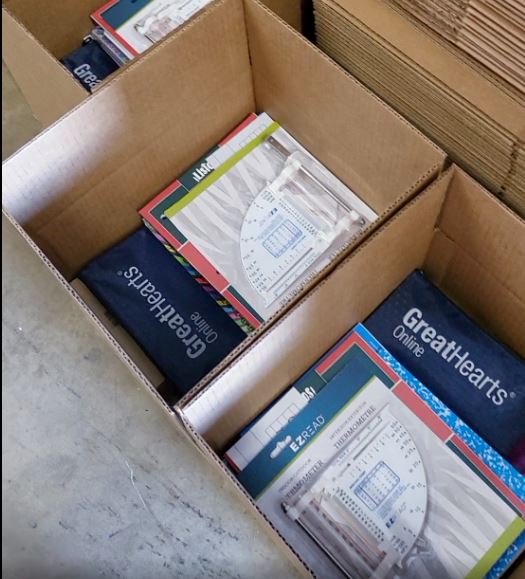
Designed specifically for the Kindergarten experience, this kit includes all required curriculum materials students will use throughout the year — from literature books and textbooks to science experiment supplies, math manipulatives, and other hands-on learning resources.
Please note: Standard school supplies such as notebooks, paper, pencils, and crayons are not included and can be purchased as a separate bundle with our supply partner at http://1stdayschoolsupplies.com/gs/598080772 or parents can purchase items individually from any online or local department store using the School Supply List.
REFUND POLICY: Scholar Success Kits are not eligible for refunds once shipped.
Designed specifically for the 1st Grade experience, this kit includes all required curriculum materials students will use throughout the year — from literature books and textbooks to science experiment supplies, math manipulatives, and other hands-on learning resources.
Please note: Standard school supplies such as notebooks, paper, pencils, and crayons are not included and can be purchased as a separate bundle with our supply partner at http://1stdayschoolsupplies.com/gs/598080772 or parents can purchase items individually from any online or local department store using the School Supply List.
REFUND POLICY: Scholar Success Kits are not eligible for refunds once shipped.
Designed specifically for the 2nd Grade experience, this kit includes all required curriculum materials students will use throughout the year — from literature books and textbooks to science experiment supplies, math manipulatives, and other hands-on learning resources.
Please note: Standard school supplies such as notebooks, paper, pencils, and crayons are not included and can be purchased as a separate bundle with our supply partner at http://1stdayschoolsupplies.com/gs/598080772 or parents can purchase items individually from any online or local department store using the School Supply List.
REFUND POLICY: Scholar Success Kits are not eligible for refunds once shipped.
Designed specifically for the 3rd Grade experience, this kit includes all required curriculum materials students will use throughout the year — from literature books and textbooks to science experiment supplies, math manipulatives, and other hands-on learning resources.
Please note: Standard school supplies such as notebooks, paper, pencils, and crayons are not included and can be purchased as a separate bundle with our supply partner at http://1stdayschoolsupplies.com/gs/598080772 or parents can purchase items individually from any online or local department store using the School Supply List.
REFUND POLICY: Scholar Success Kits are not eligible for refunds once shipped.
Designed specifically for the 4th Grade experience, this kit includes all required curriculum materials students will use throughout the year — from literature books and textbooks to science experiment supplies, math manipulatives, and other hands-on learning resources.
Please note: Standard school supplies such as notebooks, paper, pencils, and crayons are not included and can be purchased as a separate bundle with our supply partner at http://1stdayschoolsupplies.com/gs/598080772 or parents can purchase items individually from any online or local department store using the School Supply List.
REFUND POLICY: Scholar Success Kits are not eligible for refunds once shipped.
Designed specifically for the 5th Grade experience, this kit includes all required curriculum materials students will use throughout the year — from literature books and textbooks to science experiment supplies, math manipulatives, and other hands-on learning resources.
Please note: Standard school supplies such as notebooks, paper, pencils, and crayons are not included and can be purchased as a separate bundle with our supply partner at http://1stdayschoolsupplies.com/gs/598080772 or parents can purchase items individually from any online or local department store using the School Supply List.
REFUND POLICY: Scholar Success Kits are not eligible for refunds once shipped.
Designed specifically for the 6th Grade experience, this kit includes all required curriculum materials students will use throughout the year — from literature books and textbooks to science experiment supplies, math manipulatives, and other hands-on learning resources.
Please note: Standard school supplies such as notebooks, paper, pencils, and crayons are not included and can be purchased as a separate bundle with our supply partner at http://1stdayschoolsupplies.com/gs/598080772 or parents can purchase items individually from any online or local department store using the School Supply List.
REFUND POLICY: Scholar Success Kits are not eligible for refunds once shipped.
Designed specifically for the 7th Grade experience, this kit includes all required curriculum materials students will use throughout the year — from literature books and textbooks to science experiment supplies, math manipulatives, and other hands-on learning resources.
Please note: Standard school supplies such as notebooks, paper, pencils, and crayons are not included and can be purchased as a separate bundle with our supply partner at http://1stdayschoolsupplies.com/gs/598080772 or parents can purchase items individually from any online or local department store using the School Supply List.
REFUND POLICY: Scholar Success Kits are not eligible for refunds once shipped.